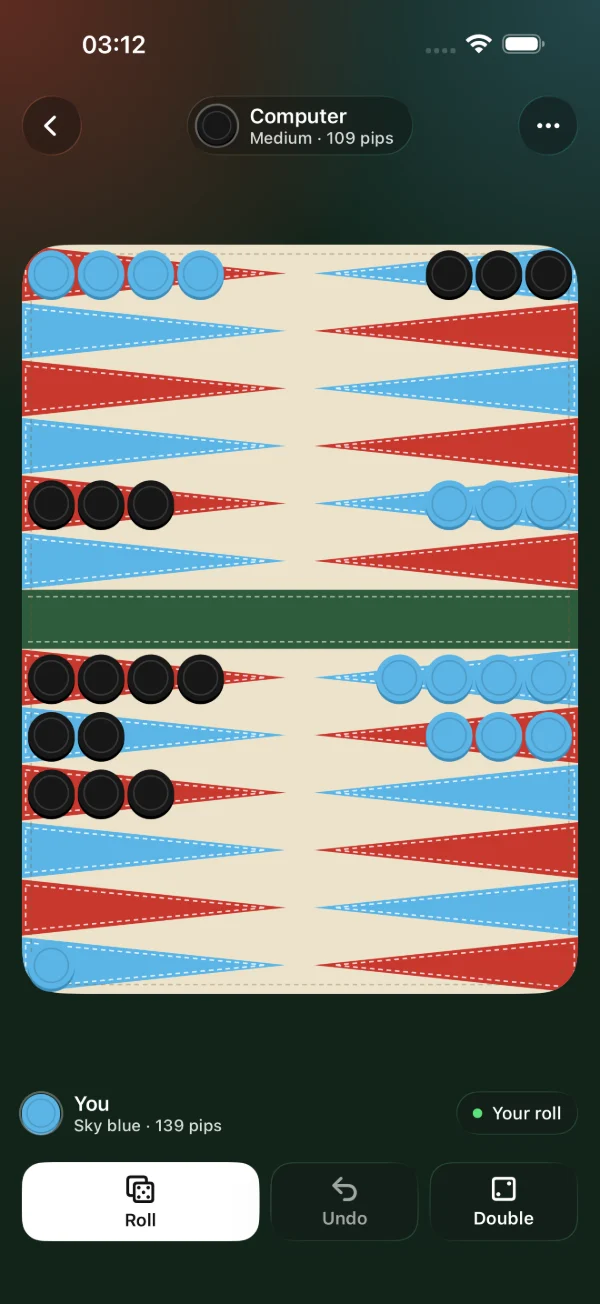
The board and the goal
A backgammon board has 24 points, twelve on each side, split into four quarters of six. Down the middle runs the bar, where hit checkers wait to come back into play.
Each player has 15 checkers. The players move in opposite directions: each one brings their checkers round into their own home board, then bears them off. The first player to bear off all 15 checkers wins.
Each player numbers the points from their own side: point 24 is the farthest, point 1 the nearest to bearing off, and the home board is points 1 to 6. The two numberings mirror each other and always add up to 25 — your 24-point is your opponent's 1-point, your 13-point is their 12-point.
Backgammon setup
Unlike long nardy, backgammon starts with checkers spread over the board. From each player's own side the setup is:
- 2 checkers on the 24-point, in the opponent's home board;
- 5 checkers on the 13-point;
- 3 checkers on the 8-point;
- 5 checkers on the 6-point, in your own home board.
The position is symmetrical: your opponent's checkers sit on the same numbers, counted from their side. Your two back checkers on the 24-point have the longest way home, so getting them moving early is often a good idea.
How to move
Who goes first
Each player rolls one die. The higher number goes first and plays those two numbers straight away, without rolling again. On a tie, both roll again.
Two dice, two moves
Each number is a separate move of one checker that many points forward. With 6-4 you can move one checker 6 and another 4, or one checker 10 in total, as long as at least one intermediate landing point is open. Doubles are played four times: 3-3 gives you four moves of three points.
A checker may land on an empty point, on a point you already hold, or on a point with exactly one opposing checker — which hits it. A point with two or more opposing checkers is closed.
Play as much of the roll as you can
You can't pass by choice. If both numbers can be played, you must play both. If only one of the two can be played, you must play the larger one whenever possible. Doubles are played as fully as the position allows.
Example: you roll 6-2 and whichever number you play first, the other one is then blocked. If the 6 can be played, you must play the 6, not the 2. And if both numbers fit only in one particular order, you must play that order.
Blots, hitting and the bar
A single checker alone on a point is a blot. If your opponent lands on your blot, your checker is hit and goes to the bar in the middle of the board. It has to start its journey again from your opponent's home board.
- Enter first. While you have a checker on the bar you can't move anything else. Every checker on the bar must come back in first.
- Entering is into the opponent's home board. A 1 enters on your 24-point, a 6 on your 19-point — the six points of your opponent's home board.
- Closed points block entry. If the point a die shows holds two or more opposing checkers, you can't enter with that number. If it holds a single opposing checker, you hit it.
- No entry, no move. If neither number lets you enter, your turn passes to your opponent.
Example: you have a checker on the bar and roll 5-2. If your opponent holds both their 5-point and their 2-point, you can't enter and lose the turn. If only the 5-point is closed, enter with the 2 on your 23-point and play the 5 with any checker — including the one that just came in.
Bearing off
You may bear off once all your checkers are in your home board — points 1 to 6 — or already borne off, and none is on the bar.
- An exact number bears off a checker from that point: a 6 from the 6-point, a 2 from the 2-point.
- A higher number may bear off a checker from a lower point only if you have no checkers on higher points. You roll a 6 and your highest checker is on the 4-point — it comes off.
- If the point shown is empty but you have checkers higher up, you must move instead. You roll a 5, the 5-point is empty and the 6-point is not: play, for example, 6→1.
- You may also make a normal move inside your home board instead of bearing off.
If one of your checkers is hit while you are bearing off, it goes to the bar and you can't bear off again until it has re-entered and come all the way home. That is why the last few turns call for care with blots while your opponent still has a checker on the bar or in your home board.
Single wins, gammons and backgammons
The first player to bear off all 15 checkers wins. How big the win is depends on how far behind the loser is:
| Result | Condition | Points |
|---|---|---|
| Single win | the loser has borne off at least one checker | 1 |
| Gammon | the loser has borne off no checkers | 2 |
| Backgammon | a gammon, and the loser still has a checker on the bar or in the winner's home board | 3 |
Points are multiplied by the value of the doubling cube: a backgammon with the cube on 2 is 3 × 2 = 6 points. If a player drops a double, the doubler wins the stake as it was before the double, with no gammon or backgammon multiplier.
The doubling cube
The doubling cube is a die marked 2, 4, 8, 16, 32 and 64. It shows what the game is worth and who may raise the stake next.
- At the start the cube is in the middle and the stake is 1.
- You may offer a double only at the start of your own turn, before rolling. You can do it if you own the cube, or if the cube is still in the middle.
- Your opponent answers. Take: the stake doubles and the cube goes to them, so only they can offer the next double. Drop: the game ends at once and you win the stake as it was before the double.
- The limit is 64. No doubles are possible after that.
Example: you double to 2 and your opponent takes. Later they redouble to 4, you take — and win a gammon. That is 4 × 2 = 8 points.
Double when your position is clearly better but your opponent can still take. Drop when your chances are slim: losing one stake beats losing double the stake, perhaps with a gammon on top.
Backgammon vs long nardy
| Backgammon | Long nardy | |
|---|---|---|
| Setup | 24×2, 13×5, 8×3, 6×5 | all 15 checkers on the head (24) |
| Direction | players move towards each other | both move the same way |
| Hitting and the bar | yes | no; you can't land on an opponent's point |
| Head | no limit | one checker per turn, exception for 3-3, 4-4, 6-6 |
| Block of six | always allowed | only if an opposing checker is already past it |
| Results | single ×1, gammon ×2, backgammon ×3 | oin ×1, mars ×2 |
| Cube in Tavla by default | on | off |
Backgammon is a tactical game: hitting, blots and the bar keep it sharp, and one roll can turn it around. Long nardy is calmer, closer to a positional race. Learn it on the long nardy rules page.
Play backgammon in Tavla
Classic backgammon is one of Tavla's two modes, next to long nardy. Tavla is free: play the computer or a friend online. The computer has three levels — Easy, Medium and Hard — and for each mode it has learned from a million games against itself.
- On iPhone and iPad you can play the computer without an account.
- In a browser and as a Telegram Mini App after signing in with Telegram or Apple.
- With a friend live (60 seconds per move) or by correspondence (72 hours per move).
- Dice come from a cryptographic random number generator; in online games the server rolls them.
The rules in the app are exactly the ones on this page. More about Tavla.
Questions
What happens when a checker is hit?
It goes to the bar. Until it re-enters into your opponent's home board on the point a die shows, you can't move any other checker.
What is a gammon in backgammon?
A gammon is a win where the loser has not borne off a single checker. It is worth 2 points, multiplied by the doubling cube.
What is a backgammon?
A backgammon is a gammon where the loser also still has a checker on the bar or in the winner's home board. It is worth 3 points.
When can I offer a double?
Only at the start of your turn, before rolling, and only if the cube is in the middle or yours. Your opponent either takes or drops and loses the current stake.
Can I bear off with a checker on the bar?
No. You may bear off only when all your checkers are in your home board or already off, and the bar is empty.
Can I skip a move I don't like?
No. If both numbers can be played you must play both; if only one, you must play the larger. You only pass when there is no legal move.