The board and the goal
Long nardy uses the same board as backgammon: 24 points, twelve on each side, split into four quarters of six. Each player has 15 checkers and one job — take every checker once around the board, gather them in the home quarter and bear them all off first.
Each player counts the points from their own side. Point 24 is the head, where all checkers start; point 1 is the last point before bearing off. Your home is your points 1 to 6. When this page says "point 18" or "your 12th point", the number is from the point of view of the player who is moving.
These rules follow the official Rules of the sport "nardy" approved by the Ministry of Sport of Russia (order No. 347 of 30 April 2025). Where Tavla makes its own choice, it is marked separately.
Long nardy setup
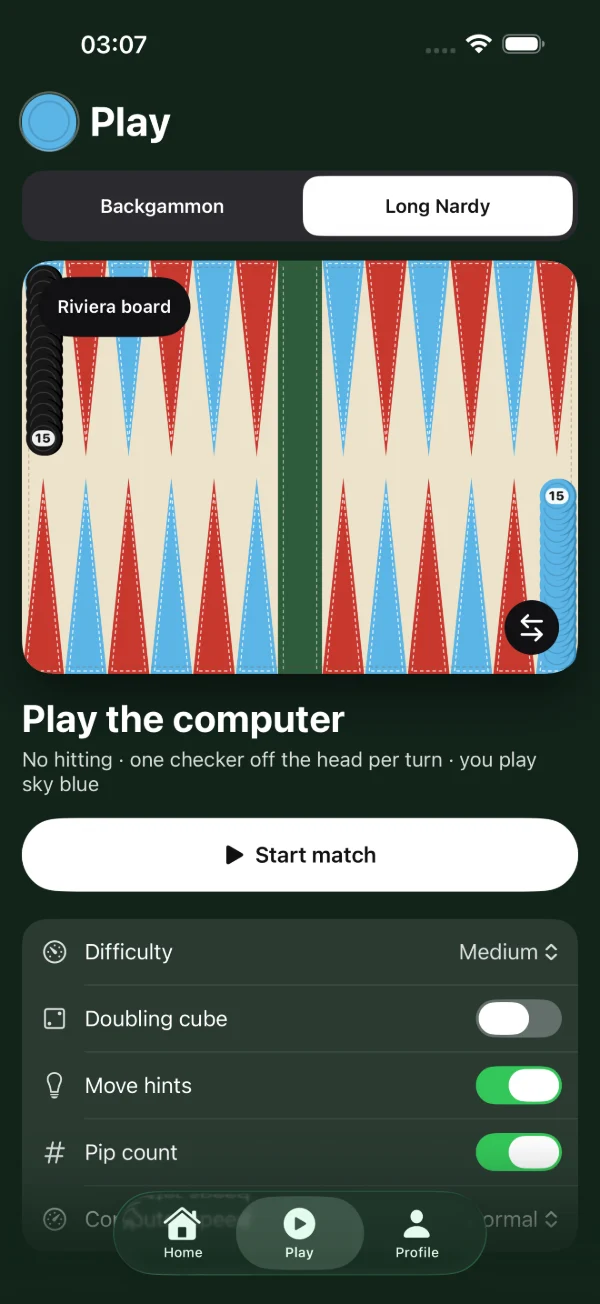
The starting position could not be simpler: all 15 checkers of each player stand on a single point, their head. The two heads sit in diagonally opposite corners of the board.
Your opponent's head is your 12th point, exactly halfway round your track. Remember that — it explains the head rule for doubles below.
How the checkers move
Both players move in the same direction, anticlockwise. Unlike backgammon, nobody moves towards the other. Every checker travels from the head through points 23, 22, 21 and on down to point 1, and it can only be borne off from home.
Your route crosses your opponent's half of the board. From your starting quarter, checkers run through your opponent's home, then through the quarter with your opponent's head, and only then reach your own home. Checkers of both colours keep meeting on the same points, which is where the key rule of long nardy comes in: you may never land on a point your opponent occupies.
How to play a turn
Who goes first
Before the game each player rolls one die. The higher number moves first and plays those two numbers straight away, without a new roll. On a tie, both roll again. So the opening move of a game is never a double — a double can only come from the next roll on.
Two dice, two moves
Each number is a separate move of one checker that many points forward. With 5-3 you can move one checker 5 and another 3, or one checker 8 in total — first 5 then 3, or the other way round.
- Doubles are played four times. A roll of 4-4 gives four moves of four points, with one, two or four checkers.
- You can't land on an opponent's point. A point with even one opposing checker is closed. There is no hitting and no bar in long nardy.
- Moving the total needs an open stop. To move one checker 8 with 5-3, the intermediate point in at least one order — after the 5 or after the 3 — must be empty or yours.
- Any number of your own checkers can share a point.
Play as much of the roll as you can
You can't pass by choice. If both numbers can be played, you must play both, even when the move is bad for you. If only one of the two numbers can be played, you must play the larger one whenever possible. Doubles are played as fully as the position allows: two, three or all four moves.
Example: you roll 6-1. Say that after the 6 there is nowhere left for the 1, but if you start with the 1, the 6 still fits. Then you must play the order that uses both dice. If no move exists at all, the turn passes to your opponent.
The head rule
The head is point 24, where all your checkers start. The defining rule of long nardy: only one checker may leave the head per turn. That checker can play both numbers — with 5-2, 24→19→17 is fine — but you can't take two checkers off the head, 24→19 and 24→22.
That is why the opening is slow: at most one new checker leaves the head each turn, and the other numbers have to be played by checkers already in the game. On your very first turn there are none, so one checker from the head plays both numbers.
The exception for 3-3, 4-4 and 6-6
If the second player's first roll is 3-3, 4-4 or 6-6, they take two checkers off the head. The reason: on these doubles a single checker from the head runs into the opponent's head on point 12. With 6-6 it would only reach point 18, with 4-4 point 16, with 3-3 point 15, and part of the roll would be lost.
With two checkers the double goes much further. With 4-4, for example, both checkers play 24→20→16 — all four moves. With 3-3 all four moves are played too. With 6-6 you get two sixes instead of one, 24→18 and 24→18; beyond point 18 the opponent's head still blocks the way.
On the other doubles — 1-1, 2-2 and 5-5 — only one checker leaves the head as usual: the opponent's head is not in its way.
The six-point block
Checkers on several points in a row form a block: your opponent can't land on them and has to jump over. A block of six points in a row can't be jumped at all — no single die moves more than six points.
So the rules limit such blocks: you may hold six points in a row only if at least one of your opponent's checkers is already past the block — ahead of it on its route, or borne off. You can never shut in all 15 of your opponent's checkers.
- Checked after every single step. A forbidden block can't exist even for a moment. Making the sixth point with your first number and breaking it with your second is still illegal.
- "In a row" follows your opponent's route. A block can wrap from one side of the board to the other where your opponent's route turns the corner.
- Five in a row is always allowed. Only the sixth point is restricted.
Example: your checkers hold points 11, 10, 9, 8 and 7, right in front of your opponent's head. While none of your opponent's checkers has got past this stretch, you may not land on point 6 — that would make six in a row. As soon as one opposing checker is beyond it, point 6 is yours to take.
Bearing off
You may start bearing off only when all 15 of your checkers are in your home, on points 1 to 6.
- A number bears off a checker from the point with that number: a 6 from point 6, a 3 from point 3.
- If that point is empty and there are no checkers on higher points, the checker comes off the nearest lower occupied point. You roll a 6 and your highest checker is on point 4 — it comes off.
- If the point is empty but you have checkers higher up, you can't bear off from a lower point — play the number as a move inside your home. You roll a 4, point 4 is empty and point 5 has checkers: play, for example, 5→1.
- Bearing off is not compulsory when a normal move exists; you may move a checker inside your home instead.
Example: your home has checkers on points 6, 3 and 1, and you roll 5-2. Start with the 5 and you can't bear off: point 5 is empty and point 6 is occupied, so the 5 is played as 6→1. Order matters — start with the 2 instead, 6→4, and with nothing above point 4 the 5 bears that checker off.
Oin, mars and scoring
The first player to bear off all 15 checkers wins. How many points the win is worth depends on whether the loser managed to bear off anything.
| Result | Condition | Points |
|---|---|---|
| Oin (simple win) | the loser has borne off at least one checker | 1 |
| Mars | the loser has borne off no checkers | 2 |
There is no triple win in long nardy: the ×3 backgammon (koks) exists only in the classic game. If the doubling cube is in play, points are multiplied by its value: a mars with the cube on 4 is worth 2 × 4 = 8 points.
The doubling cube in long nardy
The official rules allow the doubling cube in long nardy too. Before rolling, a player may offer to double the stake; the opponent either takes and owns the cube, or drops and loses the current stake at once. The full mechanics are in the backgammon rules, where the cube is used more often.
Long nardy vs backgammon
If you already know backgammon, here is what changes in long nardy:
| Backgammon | Long nardy | |
|---|---|---|
| Setup | 24×2, 13×5, 8×3, 6×5 | all 15 checkers on the head (24) |
| Direction | players move towards each other | both move the same way |
| Hitting and the bar | yes | no; you can't land on an opponent's point |
| Head | no limit | one checker per turn, exception for 3-3, 4-4, 6-6 |
| Block of six | always allowed | only if an opposing checker is already past it |
| Results | single ×1, gammon ×2, backgammon ×3 | oin ×1, mars ×2 |
| Cube in Tavla by default | on | off |
The full rules of the other game are on the backgammon rules page.
Play long nardy in Tavla
Long nardy is one of Tavla's two modes, next to classic backgammon. Tavla is free: play the computer or a friend online. The computer has three levels — Easy, Medium and Hard — and for each mode it has learned from a million games against itself.
- On iPhone and iPad you can play the computer without an account.
- In a browser and as a Telegram Mini App after signing in with Telegram or Apple.
- With a friend live (60 seconds per move) or by correspondence (72 hours per move).
- Move hints and the pip count are switches, and there are three boards: Riviera, Denim and Memphis.
The rules in the app are exactly the ones on this page. More about Tavla.
Questions
Can you hit checkers in long nardy?
No. Long nardy has no hitting and no bar. You simply cannot land on a point that holds even one of your opponent's checkers.
How many checkers can leave the head in one turn?
One. The only exception is the second player's first roll: with 3-3, 4-4 or 6-6 they take two checkers off the head.
What is a mars in long nardy?
A mars is a win where the loser has not borne off a single checker. It scores 2 points instead of 1.
Can I make six points in a row?
Only if at least one of your opponent's checkers is already past that stretch. You can never trap all 15 opposing checkers behind a six-point block, not even for one step within a turn.
Is long nardy the same as long backgammon?
Yes. Long backgammon is the usual English name for long nardy; it is also called narde. All checkers start on the head, both players move the same way and there is no hitting.
Do I have to use both dice?
Yes, whenever possible. If only one number can be played, you must play the larger one. You only pass when there is no legal move at all.